By Shirley Murtha
Springtime is when most Northern Mockingbirds return to Granby, though some hardy individuals stay here year-round. Of course, you may not recognize them by their song, since they have over 200 of those, not to mention the 30 other bird songs they can mimic – those being the talent that gives them their common name. In addition to other birds, these clever birds can imitate all sorts of sounds from crickets and barking dogs to squeaky hinges and car alarms.
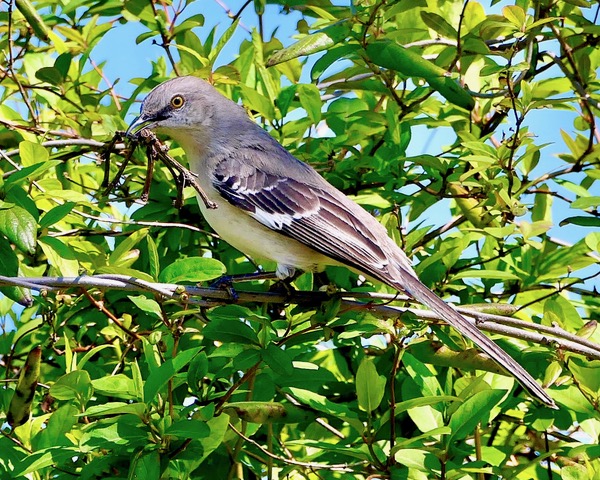
Northern Mockingbirds are some of the larger songbirds, measuring nine to 11 inches from beak to tip of their long tail. There are hardly any physical differences between the striking gray and white males and females other than the males being slightly larger, and both sexes sing and mimic. The Book of American Birds notes that research has not discovered any evolutionary benefit to the vocal calisthenics of these birds. It seems to exist for “the sheer joy of it.”
Northern Mockingbird nests are basically a cup of twigs with some grass tucked in, placed from four to 12 feet up in a shrub or tree. Three to six pale bluish/green eggs with brown spots are incubated for 12 days by the female. Once they hatch, the male actively helps with the feeding, which continues even after the fledglings are taking short flights but spending a lot of time on the ground. The chicks usually leave the nest in 10 to 13 days.
During the time of nesting, Northern Mockingbirds become quite territorial. They will attack crows and grackles that have an eye on the eggs or chicks, and even cats who venture close to the nest.
Northern Mockingbirds’ favorite habitats include residential lawns and gardens, open woody areas and farmland. They are omnivores, feeding on insects such as beetles, ants and grasshoppers and arachnids such as spiders, in the warm seasons, and berries, suet and seeds during the winter. If you see a Northern Mockingbird hopping along the ground, flashing its wings open and closed, it is flushing out insects to eat. It also does this to distract predators during nesting season.
Once found mainly in the southern United States, Northern Mockingbirds have been steadily moving northward and can now be found throughout the continental United States, Mexico and the Caribbean. They are honored as the state bird of Arkansas, Florida, Mississippi, Tennessee and Texas.
Sturdy birds, they live up to eight years in the wild, up to 20 in captivity. If you see one up close, say hello; it might say hello back!
You can see a large picture of the Northern Mockingbird on the kiosk on the Holcomb Farm Tree Trail. There is a question for kids there, too.